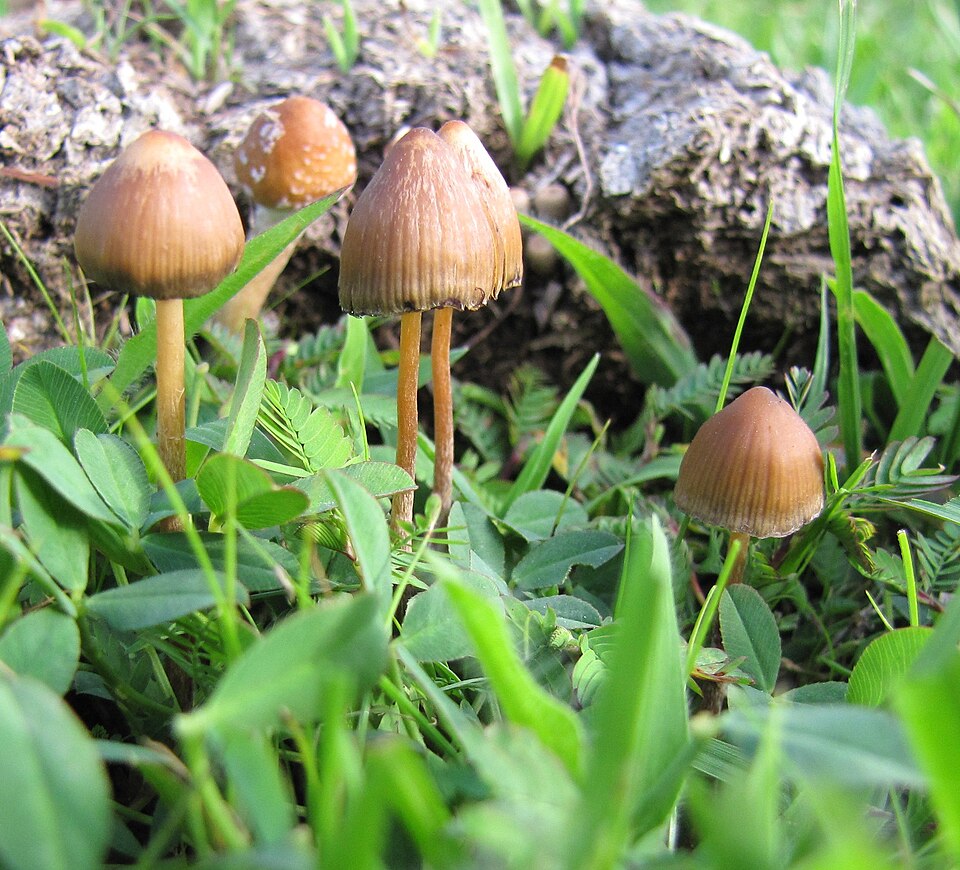
A Mazatec healer named María Sabina was administering mushrooms the old way, at night, by candlelight and in a ceremony she called a velada, chanting over people who came to her sick.
In 1955, a New York banker and amateur mycologist named R. Gordon Wasson talked his way into one of her ceremonies and became, by his own account, the first outsider to eat the mushrooms and write down what happened. His account ran in Life two years later under a very interesting title “Seeking the Magic Mushroom” and the name stuck to the plant for good. It cost Sabina dearly, obviously. The flood of seekers her sudden fame set off got her run out of her own village.
In a supervised, and even unsupervised session today, a person lies down, puts on an eyeshade, and listens to a curated playlist while they go on their shroom journey. What they describe afterwards…
The usual boundary between self and everything else goes soft, there’s a sense of contact with something larger than themselves, sometimes a visit from someone they’ve lost. Run that protocol on people with a life-threatening diagnosis specifically, and the numbers get hard to look away from, a single high dose, and roughly seven in ten participants later rank the night among the five most meaningful experiences of their entire life, up there with the birth of a child. In particular, the fear of dying tends not to come back the way it was.
None of it, as far as anyone can tell, was built for us. The genes a mushroom uses to make psilocybin turn up scattered across unrelated species of dung and wood-rotting fungi, the signature of genes that jumped between species. Also the leading explanation for why any fungus bothered is almost insulting. The compound looks like an insect deterrent, evolved to make the mushroom taste bad, or think badly, to the beetles that would otherwise eat it before it spread its spores.
Once swallowed, psilocybin converts within minutes to psilocin, which doesn’t stop at the receptor responsible for the visions. It walks directly into TrkB and wedges itself into a channel running through the receptor’s own membrane-spanning segment, prying the whole structure into a shape roughly a thousand times more sensitive to its natural signal than basic antidepressants medicinal chemists spent decades engineering to do exactly that job.
What the drug does next
Blocks that one pocket, and the antidepressant-like effects disappear, while the hallucinations carry on completely unbothered.
TrkA and TrkB are cousins by gene duplication, products of the same ancient tyrosine-kinase lineage, and they still show it. Line up their kinase domains and roughly six residues in every ten are identical. Their AlphaFold-predicted structures and the two practically trace each other outline for outline, especially through the transmembrane segment.
This is the exact region where a 2023 study out of Eero Castrén’s lab in Helsinki pinpointed psilocin’s binding pocket on TrkB. TrkA answers to a different growth factor, nerve growth factor rather than BDNF, but once activated it fires the identical downstream relay. Which is the same MAPK cascade, the same PI3K/Akt survival signaling, the same calcium-mobilizing PLCγ pathway that TrkB uses to build new synapses.
Structurally and functionally, TrkA is close enough to TrkB that biology has trouble telling them apart in some contexts.
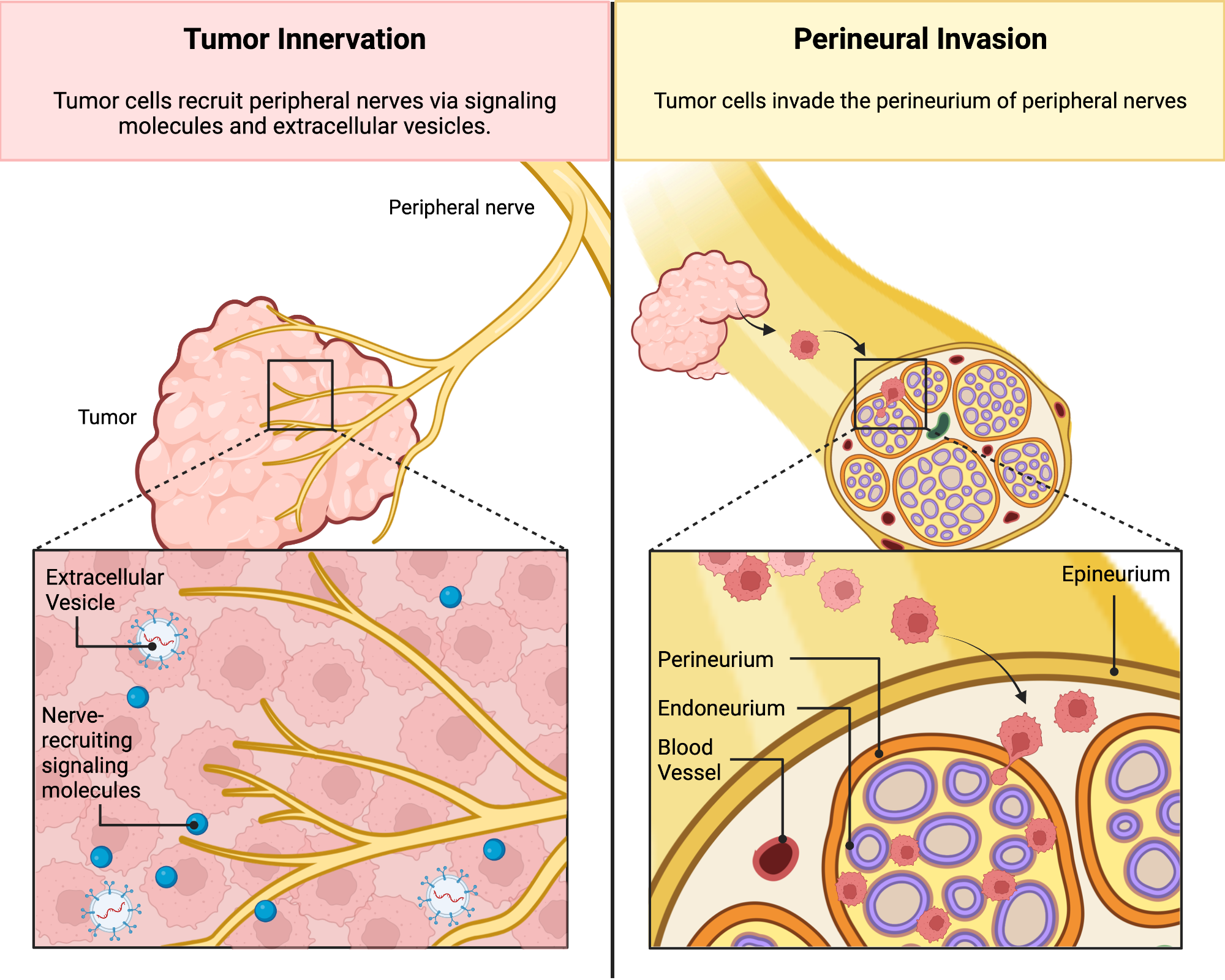
Pancreatic ductal adenocarcinoma doesn’t behave like most solid tumors. Instead of waiting for a blood vessel or a lymphatic channel to hitch a ride out of the pancreas, it grows into nerves directly, a pattern called perineural invasion. This shows up in the overwhelming majority of resected specimens. Cancer cells chemotax toward the nearest nerve fascicle, breach its protective sheath, and travel inside it as a corridor
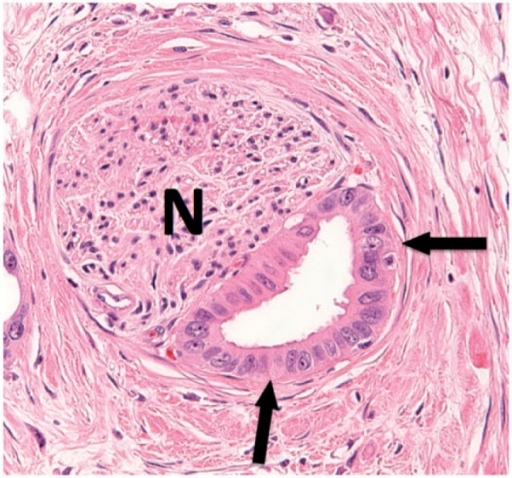
It’s also why pancreatic cancer produces some of the most severe pain in solid-tumor oncology.
And the whole process runs on the same molecular grammar as neuroplasticity — the tumor secretes nerve growth factor, activates TrkA on both itself and the adjacent nerve, and the nerve responds by sprouting toward the tumor in return. Each side is, in the most literal biochemical sense, growing toward the other.
When researchers sequenced the whole genomes of early-stage tumors in 2012, mutations in the genes that guide axons toward their targets turned out to be among the most recurrent alterations in the cancer’s genome, as fundamental to its identity as the KRAS mutations that drive nearly every case.
Trkb isn’t confined to the nerves running through the tumor’s edges. It’s expressed on the pancreatic cancer cells themselves, where it helps cancer cells let go of their epithelial identity and resist anoikis, the death a cell is normally sentenced to the moment it loses its grip on surrounding tissue.
Anoikis resistance is the property a cancer cell needs to survive the trip through the bloodstream and found a metastasis somewhere else. So the receptor that psilocin was shown to sensitize with is expressed on the tumor cells, directly relevant to how the cancer spreads.
The results described earlier (the sustained relief, the fear of dying loosening its grip) held up again in a second, independent trial published the same week in 2016, this time out of NYU. Patients with pancreatic cancer are, if anything, the population with the most to gain from that kind of intervention, carrying some of the heaviest psychological burden of any cancer diagnosis. Taking that option away from them on the basis of an untested structural argument would be its own kind of harm.
Over the Last decade
Cancer neuroscience has been building the case that nerves are not passive bystanders in tumor growth but active participants recruited by the tumor itself.
Psychiatric neuroscience has discovered that its most promising new therapy works by directly rewiring a growth-factor receptor.
Whether concurrent TrkA and TrkB activation in a pancreatic tumor produces nothing worth worrying about is mostly unknown. amplifies the invasion the tumor already relies on, or actually gets in its own way, is, well, mostly unknown. All three outcomes are mechanistically defensible, and we can only hope for…
Further Reading
Wasson, R.G. (1957, May 13). Seeking the magic mushroom. Life, 42(19), 100–120.
Reynolds, H.T., Vijayakumar, V., Gluck-Thaler, E., et al. (2018). Horizontal gene cluster transfer increased hallucinogenic mushroom diversity. Evolution Letters, 2(2), 88–101. https://doi.org/10.1002/evl3.42
Moliner, R., Girych, M., Brunello, C.A., et al. (2023). Psychedelics promote plasticity by directly binding to BDNF receptor TrkB. Nature Neuroscience, 26(6), 1032–1041. https://doi.org/10.1038/s41593-023-01316-5
Bapat, A.A., Hostetter, G., Von Hoff, D.D., & Han, H. (2011). Perineural invasion and associated pain in pancreatic cancer. Nature Reviews Cancer, 11, 695–707. https://doi.org/10.1038/nrc3131
Biankin, A.V., Waddell, N., Kassahn, K.S., et al. (2012). Pancreatic cancer genomes reveal aberrations in axon guidance pathway genes. Nature, 491(7424), 399–405. https://doi.org/10.1038/nature11547
Griffiths, R.R., Johnson, M.W., Carducci, M.A., et al. (2016). Psilocybin produces substantial and sustained decreases in depression and anxiety in patients with life-threatening cancer. Journal of Psychopharmacology, 30(12), 1181–1197. https://doi.org/10.1177/0269881116675513
Ross, S., Bossis, A., Guss, J., et al. (2016). Rapid and sustained symptom reduction following psilocybin treatment for anxiety and depression in patients with life-threatening cancer. Journal of Psychopharmacology, 30(12), 1165–1180. https://doi.org/10.1177/0269881116675512
Wiesmann, C., Ultsch, M.H., Bass, S.H., & de Vos, A.M. (1999). Crystal structure of nerve growth factor in complex with the ligand-binding domain of the TrkA receptor. Nature, 401(6749), 184–188. https://doi.org/10.1038/43705
Notes
This post is adapted from a longer manuscript, “Convergent Neurotrophic Signaling,” proposing a preclinical framework for investigating this interface directly.